

Melasma Treatment
Melasma patches tend to appear slowly and return quickly whenever care is interrupted. Understanding your type is the first step toward a protocol that truly works.
Before and after
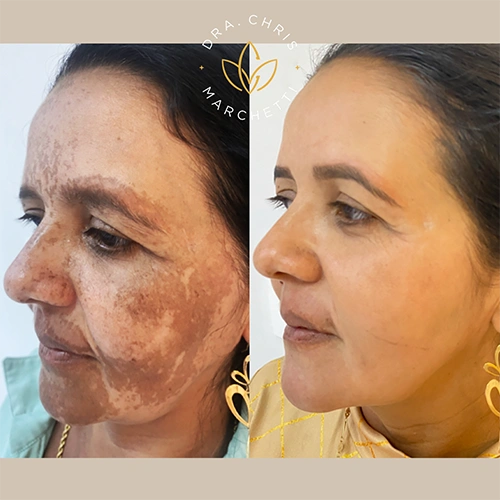
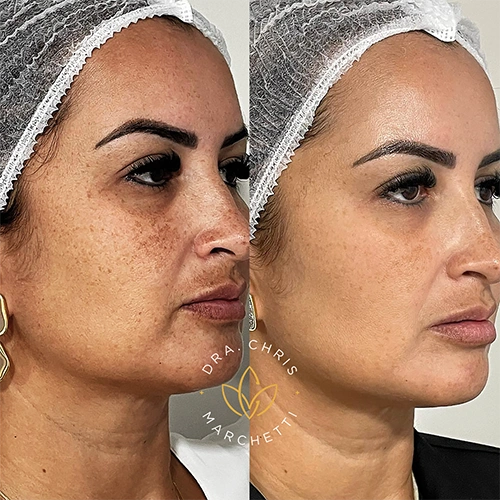
Why this treatment matters
Melasma shows up as brownish patches, usually on the forehead, upper lip, cheeks or chin, and mostly affects women — often linked to pregnancy, birth control use or family history. But the trigger almost everyone underestimates is solar radiation, including everyday visible light, which stimulates melanocytes to produce even more pigment.
With the help of a Wood's lamp, melasma can be classified as epidermal (the most superficial, with the best response to treatment), dermal or mixed — and this classification is what guides the choice of the most suitable protocol. Being a chronic condition, melasma tends to fluctuate throughout life, reacting to seasons, hormones and accumulated sun exposure.
The most modern and effective options
At Instituto Splendore, the foundation of the depigmenting protocol is a program of depigmenting chemical peels, applied in sessions and intensities calibrated to the type and depth of your melasma, combined with continuous-use products prescribed in-office.
No protocol works, however, without its most important pillar: strict, daily photoprotection, including on cloudy days and in front of screens and artificial light. Without this care, the patches tend to return within a few weeks. Because it is a chronic condition, periodic follow-up and maintenance of the protocol are what sustain a natural, safe and long-lasting result — always with an exclusive, personalized approach, defined during a personalized consultation with Dra. Chris Marchetti's team.
Here, no treatment is off-the-shelf
There is no single formula. In the assessment consultation, Dr. Chris Marchetti studies your case — your body, your routine and your goal — and designs the exclusive combination of technologies, methods and protocols that makes sense for you.
Questions about Melasma Treatment
Is there a cure for melasma?
What is Skin Melan Peel®?
Why does my melasma come back even after it has lightened?
How is the type of my melasma determined?
Can pregnant women treat melasma?
How long does it take to see results?
Shall we take care of you?
Melasma calls for consistency and the right protocol from day one. Book your personalized consultation with Dra. Chris Marchetti's team and discover the ideal depigmenting plan for your type of patch.